Loading...
Searching...
No Matches
viennals::OxidationConstrainedAmbient< T, D > Class Template Referencefinal
Velocity field for the oxide outer interface when part of that interface is in contact with a mask. Open oxide/ambient regions use the oxide deformation field. Mask-contact regions are kinematically constrained to the solved mask vector velocity and do not receive additional free-surface scalar growth. More...
#include <lsOxidationMask.hpp>
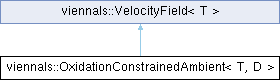
Inheritance diagram for viennals::OxidationConstrainedAmbient< T, D >:
Public Member Functions | |
| OxidationConstrainedAmbient ()=default | |
| OxidationConstrainedAmbient (SmartPointer< OxidationDeformation< T, D > > passedDeformation, SmartPointer< OxidationMaskBending< T, D > > passedMaskVelocity, SmartPointer< Domain< T, D > > passedMaskInterface, int passedMaskSign=1) | |
| OxidationConstrainedAmbient (SmartPointer< OxidationDeformation< T, D > > passedDeformation, SmartPointer< OxidationMaskBending< T, D > > passedMaskVelocity, SmartPointer< Domain< T, D > > passedMaskInterface, SmartPointer< Domain< T, D > > passedAmbientInterface, int passedMaskSign=1) | |
| Vec3D< T > | getVectorVelocity (const Vec3D< T > &coordinate, int material, const Vec3D< T > &normalVector, unsigned long pointId) final |
| Like getScalarVelocity, but returns a velocity value for each cartesian direction. | |
| T | getScalarVelocity (const Vec3D< T > &coordinate, int material, const Vec3D< T > &normalVector, unsigned long pointId) final |
| Should return a scalar value for the velocity at coordinate for a point of material with the given normalVector. | |
| T | getDissipationAlpha (int direction, int material, const Vec3D< T > ¢ralDifferences) final |
| If lsLocalLaxFriedrichsAnalytical is used as the spatial discretization scheme, this is called to provide the analytical solution for the alpha values, needed for numerical stability. | |
Static Public Member Functions | |
| template<class... Args> | |
| static auto | New (Args &&...args) |
Detailed Description
template<class T, int D>
class viennals::OxidationConstrainedAmbient< T, D >
class viennals::OxidationConstrainedAmbient< T, D >
Velocity field for the oxide outer interface when part of that interface is in contact with a mask. Open oxide/ambient regions use the oxide deformation field. Mask-contact regions are kinematically constrained to the solved mask vector velocity and do not receive additional free-surface scalar growth.
Constructor & Destructor Documentation
◆ OxidationConstrainedAmbient() [1/3]
template<class T, int D>
|
default |
◆ OxidationConstrainedAmbient() [2/3]
template<class T, int D>
|
inline |
◆ OxidationConstrainedAmbient() [3/3]
template<class T, int D>
|
inline |
Member Function Documentation
◆ getDissipationAlpha()
template<class T, int D>
|
inlinefinalvirtual |
If lsLocalLaxFriedrichsAnalytical is used as the spatial discretization scheme, this is called to provide the analytical solution for the alpha values, needed for numerical stability.
Reimplemented from viennals::VelocityField< T >.
◆ getScalarVelocity()
template<class T, int D>
|
inlinefinalvirtual |
Should return a scalar value for the velocity at coordinate for a point of material with the given normalVector.
Reimplemented from viennals::VelocityField< T >.
◆ getVectorVelocity()
template<class T, int D>
|
inlinefinalvirtual |
Like getScalarVelocity, but returns a velocity value for each cartesian direction.
Reimplemented from viennals::VelocityField< T >.
◆ New()
template<class T, int D>
template<class... Args>
|
inlinestatic |
The documentation for this class was generated from the following file:
- include/viennals/lsOxidationMask.hpp